Showing posts with label endangered species. Show all posts
Showing posts with label endangered species. Show all posts
Tuesday, August 6, 2013
Monsanto vs Democracy
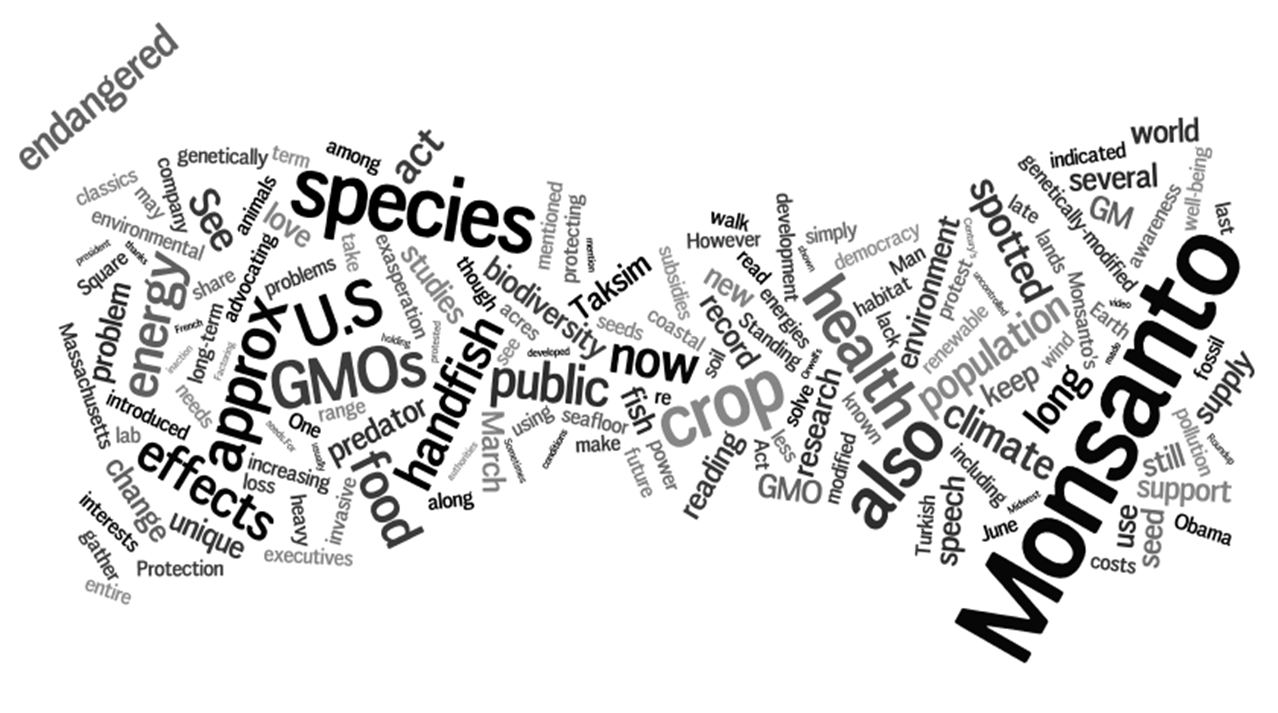
Here's a word cloud of my recent posts. How come it's easy to find Monsanto but difficult to find democracy? That "endangered" seems to be trying to tell us something too. And hey, that's not Obama under Monsanto's thumb is it? I sure hope not...


Thursday, July 4, 2013
Endangered Species Chronicles: The Spotted Handfish
 |
| The Spotted Handfish, looking unhappy to be endangered. |
In the coastal estuaries of Tasmania lives one of the most unique fish ever to walk the Earth: the spotted handfish (Brachionichthys hirsutus). One of the most endangered marine fish, this unique swimmer is also a walker, thanks to its hand-like pectoral and dorsal fins, which it uses to walk along the seafloor.
First discovered in the late 1790's by French explorer Peron, the spotted handfish was a common sight in Tasmanian waters until the 1980's when its population crashed. Reasons for the crash are unclear but possibilities include the introduction of the northern Pacific seastar (Asterias amurensis), known to be a voracious predator of shellfish and which may also eat the eggs of handfish, and deterioration of habitat due to coastal development.
Surveys in the 1990's showed the spotted handfish to be sparsely distributed and the largest colony had only 300 to 500 members. Its restricted range and low population density make it vulnerable to extinction and a captive breeding program has been launched to eventually re-introduce this unique fish back into its former range.
See incredible video of the spotted handfish walking on the seafloor at Arkive.
See an infographic on how we're endangering species here.
See Joel Sartore's portraits of many endangered animals here.
Please help raise awareness about endangered species and share this post.
Tuesday, October 23, 2012
How we're endangering species -- infographic
There's lots of cool stuff over at visual.ly to help us picture the world around us.
Here's a great infographic that summarizes the human impact on the environment and species. Overall: ouch!
(Unfortunately, the ones shown below are the marquee species... many less glamorous species are also suffering.)
Here's a great infographic that summarizes the human impact on the environment and species. Overall: ouch!
(Unfortunately, the ones shown below are the marquee species... many less glamorous species are also suffering.)

Monday, October 1, 2012
Top Ten Blog Posts
We reached a milestone last week -- 10,000 page views since our inception! (And that doesn't include an additional 6000 page views for the blog when it was formerly known as "Ecolympics".) Thanks for reading. To celebrate, I thought I'd highlight the top ten posts that are getting the most hits.
1. Environmental Cartoons I: Crisis? What Crisis? -- most people find Eco-Now by searching for the Supertramp album, "Crisis? What Crisis?" whose cover was featured in this post.
2. Portraits of Endangered Animals -- I'm a big fan of Joel Sartore and his work is highlighted here.
3. Endangered Species at the North and South Poles: The Eco-Art of Xavier Cortada -- Now that I found out about the terrific work of Miami eco-artist, Xavier Cortada, I'm a big fan of his work too. See also his Eco-Now interview, which just missed the top ten.
4. Six Great Environmental Protest Songs -- I tried to find some that weren't on everyone else's list.
5. What is Shark Finning? -- simply, it's a brutal, inhumane practice that is decimating worldwide shark populations, all for a supposed delicacy.
6. The Endangered Species Print Project -- great conservation-art project by Jenny Kendler and Molly Schafer of Chicago.
7. The Lost Bird Project -- "Forgetting is another kind of extinction," says Todd McGrain, whose work to commemorate extinct birds with larger-than life sculptures is profiled in the eponymous film (reviewed here). See also the thoughtful interview he gave.
8. Thoughts on World Population Day -- can natural resources keep up with our growing population? No.
9. How Water Chestnuts are Taking over the Northeast: A Photo-essay -- invasive species like water chestnuts are becoming a problem in ecosystems everywhere.
10. Living in an Age of Extinction: Building a Life Cairn -- Why do no church bells ring when animals go extinct? Why, indeed. Read the interview with Andreas Kornevall about the great project in East Sussex to commemorate extinct species.
Please share this post or any other post you found provocative. We need to raise awareness that we humans are part of the tree of life and the high extinction rates now seen, due to habitat destruction, pollution, over-exploitation, invasive species and climate change mean that we are failing in our role as stewards. We now know of more than 2000 other planets in the galaxy, but none of them are known to have life. It's our planet, and biodiversity is our life: we need to take care of it.
Thursday, July 26, 2012
Endangered Species for Beginners

When you're done clicking through the tabs, I highly recommend playing the Endangered Species game. Once you click on an endangered species -- you have to be quick! --you have to answer a quiz question about why that species is becoming endangered. It's all a clever way to make learning about endangered species fun. See if you can catch all eleven species to win the game!
ASR Search Engine
Tuesday, June 19, 2012
A new look at animal behavior
Two years ago, for the International Year of Biodiversity, the IUCN (International Union for the Conservation of Nature) produced a bold new video that we've featured here before, "Love, not Loss." You can see it here:
When raising awareness about such a significant problem as biodiversity loss, it's hard not to fall into the "doom and gloom" trap. But as the video points out, it's easy to tune out the doom and gloom, the litany of statistics and facts. So what moves us to act? Direct experiences of nature that remind us of its awe, beauty and wonder. I'm still thinking of the Robinson Jeffers poem Carmel Point, "we must uncenter our minds" -- it's not all about us. With that, I introduce you to this terrific TED video by Frans de Waal, who is doing research on morality in primates. It's difficult to study this sort of behavior in the wild, so de Waal recounts, and shows footage of, ingenious experiments that show reciprocity, fairness, cooperation and consolation in primates. There are some great clips, particularly at the very end, that show how similar primate behavior is to human behavior (he also has an example of cooperation with elephants). While de Waals is ultimately studying it for the evolutionary basis for morality, I think it shows the respect that these species deserve in their own right.
Sunday, June 17, 2012
Thoreau on Endangered Species

I've been reading Nature's Ghosts: Confronting Extinction from the Age of Jefferson to the Age of Ecology by Mark V. Barrow, Jr., a masterful summary of its subtitle. Unfortunately, it's four days overdue at the library. In Chapter 3, Sounding the Alarm on Continent-Wide Wildlife Extinction, he quotes a great journal entry from Thoreau in 1865:
When I consider that the nobler animals have been exterminated here, --the cougar, panther, lynx, wolverine, bear, moose, deer, the beaver, the turkey, etc., etc., -- I cannot but feel as if I live in a tamed, and as it were, emasculated country... I take infinite pains to know all the phenomena of spring, for instance, thinking that I have here the entire poem, and then, to my chagrin, I hear that it is but an imperfect copy that I possess and have read, that my ancestors have torn out many of the first leaves and grandest messages, and mutilated its pages. I should not like to think that some demigod had come before me and picked out some of the best stars. I wish to know an entire heaven and an entire earth.Look at that impressive list of megafauna that once lived in Massachusetts! Wild cats like cougars, panthers, and lynxes, none of which are were seen by Thoreau or have been seen since (though a webpage from the state lists lynx sightings in 1991). The wolverine was extirpated in Massachusetts in 1835. There are occasional bear and moose sightings, and deer are thriving, thanks to the decimation of wolves and coyotes, but it's hard not to think of the state as a "tamed, emasculated country". To think that we don't have the "entire poem... but an imperfect copy" is a tragedy not just from the actions of our ancestors but our present actions. I too "wish to know an entire heaven and an entire earth." Before it's too late.
Saturday, June 16, 2012
Endangered Species and Justin Bieber
 |
| Google Trends as collected by Saving Species |
The good people over at Saving Species had a nice post earlier this spring showing how interest in celebrity trivia absolutely drowns out more important issues like the biodiversity crisis. Biodiversity crisis? What biodiversity crisis? The one where we're losing 50 to 100 species per day to habitat destruction, pollution, introduction of invasive species, over-exploitation and climate change. Oh, that biodiversity crisis. The post goes on to mention that according to the relative volume of searches, searches for Britney Spears outnumbered "biodiversity" 23 to 1 -- that is, for every one person who searched for "biodiversity", 23 people searched for Britney Spears.
Maybe we should ask what biodiversity is (the totality of genes, species and ecosystems in a region; a measure of the health of the region) because it seems few people are searching for it on Google.
Here are the trends for five terms: biodiversity (light blue), extinction (red), endangered species (orange), pollution (green) and global warming (dark blue):
The results aren't surprising. Searches for the specific terms "extinction" and "endangered species" are twice as common as searches for biodiversity, which is a general catch-all term. Similarly, there is high concern for pollution in the environment and the effects of global warming as these outnumber "biodiversity" searches by about 5 to 1 for 2011.
To find out more about endangered species in your state, you can check out the excellent resource called the extinction memorial.org. Go to the page on US Extinction memorial and you can find out what species each state has already lost and what it's in danger of losing.
Biodiversity is the capital of the planet. Despite all the new planets found around other stars, we're still the only place in the universe with life. Our future depends on our stewardship of biodiversity, not on celebrity fads.
Thursday, May 10, 2012
Two Songs about Extinct Animals
We've been featuring artists who have been raising awareness about the extinction crisis by painting extinct or endangered species. Soon we are going to feature an interview with Randy Laist, who has compiled an alphabetical list of songs of extinct animals. Upbeat and catchy, the songs are accompanied by a great collection of images. Here are two to get you started.
Q is for Quagga:
and B is for Baiji:
Stay tuned for our interview with Randy Laist, coming soon!
Q is for Quagga:
and B is for Baiji:
Stay tuned for our interview with Randy Laist, coming soon!
Tuesday, May 1, 2012
Endangered Species Gallery
 |
| Dusky Seaside Sparrow; extinct 1987 |
Pictured at left is the dusky seaside sparrow who lost a battle with DDT and habitat destruction in Florida and had its status changed from "endangered" to "extinct" in 1987. This could be the very last one.
One of our Ecofest prizes, winners to be announced imminently, is a print of the dusky seaside sparrow by artist Joanna Barnum. Stay tuned!
.
Monday, April 23, 2012
Artists and Endangered Species: The Endangered Species Print Project
 |
| Whooping Crane; wild population/print edition: 398 |
Two more artists (see earlier post) who've been doing their part to tune us in to the biodiversity crisis are Jenny Kendler and Molly Schafer, from Chicago, who created the Endangered Species Print Project. Jenny Kendler kindly agreed to carve some time out of her incredibly busy schedule and answer some questions for me.
1. In your biographical statement, when you say you and Molly bonded in grad school over “nature-geekery,” what are we talking about here?
JK: We’re talking evening prowls for urban coyotes, pre-dawn wake-ups to see snowy owls, studious poring over (sometimes hilariously awkward) 17th-19th century naturalists prints, massive collections of found feathers, shells and skulls, shelves packed with field guides, fiction and non-fiction books about animals and nature, serious investments in good binoculars, tents, hiking boots, sketchbooks full of drawings, minor salivation when a new David Attenborough BBC documentary comes out, and a pretty much endless obsession with the endless wonder available to the (lucky) person who takes time to look closely at the natural world.
 |
| North Atlantic Right Whale; wild population/print edition: 438 |
2. That sounds delightfully geeky. When did you tune into the present extinction crisis?
JK: Honestly, I can’t remember a time when I wasn’t aware of the specter of extinction. My parents were (and are) very environmentally involved. We lived in a passive solar home, went on backpacking trips with the Sierra Club, and often spent our weekends outdoors the at the river or botanical gardens. I am endlessly grateful that they tuned me in to nature at an early age. Nature shows like NOVA and magazines like Zoobooks put the concrete names “extinction” and “endangered species” to the danger that I knew threatened many of the animals and plants that fascinated me.
Though I don’t think conservation should be reserved for adult conversations, it can be hard to talk to kids what a mess they’re inheriting. My 12 year old cousin David, who wants to be a marine biologist, recently broke my heart when he told me what he wanted most in his future career was to see the Great Barrier Reef before it’s gone.
We’d like children not to have to worry about these things -- but when David grows up he’s going to care about the world around him and I believe he’ll make a difference.
3. Oh, that is indeed a heartbreaking comment. We barely know how to talk about this crisis as adults, let alone with children.
How was the Endangered Species Print Project conceived?
How was the Endangered Species Print Project conceived?
JK: Molly and I, though we enjoy our individual artistic studio practices, were frustrated with the inability of a career confined to the traditional “white walls” gallery & art world to make a real impact on the issues we cared about. We wanted to bridge the gap between art and activism with something accessible and pragmatic, without compromising on concept or artistry. Once we came up with the model to donate 100% of the funds, and the idea that the edition was linked to the species’ numbers in the wild, we realized that despite our constantly busy schedules, we had to find a way to make this happen.
 |
| Vancouver Island Marmot; wild population/print edition: 140 |
4. Which endangered species print was first and why?
JK: There were actually 4 prints that kicked off the project: Molly’s SeychellesSheath-tailed Bat and Vancouver Island Marmot (see above) and my Indri Lemur and Panamanian Golden Frog. We released them during July and August 2009, at the beginning of the project.
We choose these particular critically endangered species for a few reasons that continue to be the guiding principles in selecting species. Whether the artists are us or others, we always want people to choose species that are personally interesting to them. In my case I was fascinated by the behaviors of the two species I initially choose. Indris have a haunting call and a unique behavior that mimics “sun worship” -- and male Panamanian Golden frogs use an amazing system of “semaphores” to communicate dominance before wrestling for prime habitat! Who could resist! There is so much to learn from the natural world.
Though we help our guest artists find species and match them with conservation organizations, we don’t want to “assign” them a species, as I think that the personal connection makes the work stronger.
We’re also really excited when we can support smaller, more targeted, conservation organizations, so we consider this when choosing a subject for a new print. Unfortunately, when researching species, it’s not uncommon to discover an amazing endangered species only to learn that barely anything is known about it, and no one is working on its conservation.
We’ve also been contacted by conservation organizations a couple times, who were hoping to have us create a print to support their work. We’ve been thrilled to find artists who were excited to make prints of these species -- for example Noah Scalin’s Vaquita print (see below) for ¡Viva Vaquita!, a great organization that’s working hard to protect these tiny porpoises.
 |
| Vaquita; wild population/print edition: 250 |
5. What sort of response have you had to the project?
JK: We have had an overwhelmingly positive response. Many people comment that the idea of linking a limited edition print with a vanishing species has really stuck in their mind. Almost since the very beginning of the project, we have been surprised and thrilled to have many artists contacting us asking to be involved, as well as many spaces that have been excited to show ESPP’s prints.
6. I think in your series only the Whooping Crane (above, top) is truly famous as an endangered species. One rarely hears about the Javan Rhinoceros or the Amur Leopard, which had a few minutes of fame on the BBC documentary, Planet Earth, yet both of these have less than 50 individuals in the wild. Why do you think we’re not hearing more about these and other critically endangered species?

JK: It’s true, species like the Javan Rhinoceros don’t receive very much attention from major media etc. -- but then think about how little attention the Dwarf Trout Lily (a rare and lovely plant with less than 14 populations remaining in the wild, see print at left) receives!
To get into why I think most endangered species don’t receive notice in the public forum would be to write a treatise about what I think are misplaced priorities in today’s consumer society. Nature does not seem to be a priority for many people, despite the fact that we ourselves are animals still living in a mostly natural world -- and so for a species to make it into the popular news, it has to be particularly big, beautiful or near home, like the Whooping Crane.
Sadly, the other likely factor is that there are just so many species that are threatened with extinction. The IUCN’s Red List, which is the most widely accepted index of endangered species, lists 61,000 species as of 2011. Of course, this is not a full count, since there is never enough funding to analyze all populations and many species become extinct before ever being counted by human beings.
Another way to understand the magnitude of the extinction crisis is through percentages. About 1 in 10 birds is endangered, 1 in 4 mammals, and 1 in 3 amphibians. When you think of it this way, the numbers are staggering.
Most people are just unaware that this is going on, so one major aim of ESPP is to raise awareness. Though nature may not be obviously prioritized in popular culture, most people do care, and find these endangered species interesting, beautiful and moving if given the chance to learn or help. The Earth is being depleted of its magnificent biodiversity, and yes, it is largely due to the actions of human beings. Fortunately, this means it’s also within our power to change things.
7. It's true, the numbers are staggering. But you're actively trying to change things -- you’ve raised over $9000 and 100% of your print sale price is going to the conservation organizations that you mention on your webpage – congratulations on your fundraising and hard work. Are you happy with how the project is going?
JK: Yes, but there’s always more work to be done, and never enough hours in the day. We’d love to be able to spend lots more time on this project, since it has been so successful and fulfilling. We’re working towards our goal!
 |
| California condor; wild population/print edition: 180 |
8. How can readers find out more about the Endangered Species Print Project and buy your unique endangered species prints?
JK: The Endangered Species Print Project is online at http://EndangeredSpeciesPrintProject.com
where you can view, read about, and purchase prints of the 21 amazing species that ESPP is supporting so far, with the help of people like you! [Three lucky Ecofest participants will be taking home Endangered Species Print Project prints.]
You can see more of Molly Schafer’s art at http://mollyschafer.com and Jenny Kendler’s art at
9. Readers are reminded that these special prints make great gifts (Mother's Day is coming up!) and that you can "like" the Endangered Species Print Project on Facebook.
JK: Thanks!
Saturday, April 7, 2012
Facing up to the Extinction Crisis

This is the time of year I start going a little crazy. It has nothing to do with doing my taxes, which I did remarkably early this year, or any crazy weather phenomena. It has everything to do with our upcoming Ecofest (signup starts on Monday) and whether we’re going to finally start taking the crisis in species loss seriously enough to do something about it.
As I research topics to blog about, including news items this week like Whole Foods finally agreeing to stop selling overfished species, pesticides being linked to honeybee decline (bees pollinate one third of the food we eat such as tomatoes, beans, apples and strawberries, so their decline has a huge effect on our food supply), and the Koch brothers, starring in the new documentary, Koch Brothers Exposed (stay tuned for a screening on campus), funding climate change denialism (I’m late to the party here, Greenpeace reported this in 2010), I keep coming back to endangered and extinct species.
It’s a bewildering crisis, with the dubious distinction that many of the species that populated our picture books when we were kids and ultimately fired our imaginations and dreams are suffering enormous declines due to habitat loss, pollution, introduction of invasive species, over-exploitation and climate change. These are all human-induced causes yet we live our lives as if this is someone else’s problem. Ultimately, we are impoverishing not only our wellbeing, because we rely on ecosystem services (with the ecosystem’s resident species) for clean water and filtering the air, we are impoverishing our imaginations and the imaginations of future generations by allowing so many species under our stewardship to go extinct. In addition, apart from whatever benefit we may enjoy from sharing the planet with so many diverse species, each species has its own inherent right to exist.
What drives me crazy is how little attention we’re paying to it. Clean/alternative/green energy has been soaking up more than its fair share of the environmental news pie but the reality is that if we were to develop an eco-friendly fuel to power our homes, cars, businesses and so on today we would still have the problem of over-consumption of natural resources, deforestation and the main drivers of species loss. We need to show more imagination in understanding and solving our environmental problems.
(I think what also drives me a little crazy is that we don't yet have a proper way to grieve for the species that we know we've lost. Since I heard the story of the golden toad on a trip to Costa Rica, I've been haunted by it: brilliantly colored males seen mating with females in temporary pools in the mountains of Monteverde for a few weeks in the spring... discovered in the 1960's, not seen outside the mating period, hundreds seen in the late 1980's, then only a few, then one year, only one golden toad searching in vain for a mate.)
This week in the New York Times, Thomas Lovejoy reported on the Planet Under Pressure conference in London . The upshot is that we’re failing to act with the scale and urgency needed. We spend our days worrying about the financial system, when really, we should be devoting our energies to understanding the workings of earth’s biological systems and making sure that they remain fully functioning. As Aldo Leopold wrote, “the number one rule of intelligent tinkering is saving all the parts”.
As always, the first step is to educate ourselves. Here at BU, you can check out the screening of the documentary Call of Life, at Rich Hall this Sunday at 7pm or at the Core House on Monday night (also at 7pm). We’ll provide the eco-friendly pizza.
Friday, February 10, 2012
The Great Challenge
I showed this to my class last week and found out that concern for species becoming extinct is very high among students, but so is pessimism that anything significant can be done in the next ten years...


Thursday, January 12, 2012
Most Endangered Species 2012
The WWF (that's World Wildlife Fund, not World Wrestling Federation) has posted their most endangered species for this year and you can see that the causes are the usual culprits of habitat destruction, overfishing, bycatch, entanglement and so on. I looked for last year's list and found one from 2010 and you can see lots of similarities. When I found this I wondered why some species were dropped and some species were added. Over at Paul Guernsey's excellent All About Wildlife site, he explains how subjective the lists are as it's not just about the number of remaining individuals, but also available habitat and public awareness as well as perceived threats that factor in. In the end, it's probably a bit like choosing your ten favorite movies -- the list changes depending on your mood. The alarming thing here is that these ten are chosen out of hundreds, if not thousands, of equally vulnerable species. Well, naming the problem is the start to solving it...
Friday, April 29, 2011
Photo of the Day: Close Strolling
 We are about to announce our own photo contest winners and I wanted to show this terrific photo from Plymouth State University's Museum of the White Mountains. On their webpage it's called "close strolling".
What a great title! Forget backbacks and water bottles and fancy hiking boots. Let's just go for a stroll together among the tall, tall pines.
From their body language you can almost sense their amiable conversation.
But can you imagine the Whites without their spectacular forest cover? One hundred years ago, deforestation was a huge problem and it was largely thanks to the efforts of one person, Philip Ayres, who went on the lecture circuit with his own lantern slides , that a national forest reserve was ultimately created.
If you go to the above exhibit, you see that the efficiency with which Ayres describes the logging companies' decimation of the forests is reminiscent of the efficiency with which we are overfishing the oceans. Still, full credit -- and profound thanks -- to Ayres for giving us all such an incredible legacy. Perhaps one of us will fill his shoes for the beleaguered fish and other endangered species.
In the meantime, I suggest taking advantage of whatever weather you've got and going for some close strolling...
Sunday, April 24, 2011
Great WWF Ads

You’ve got to hand it to the World Wildlife Fund for the creativity in their ads. Here’s a compilation of 55 compelling and provocative ads. Feel free to leave a comment about your favorites. I personally like the forest/lungs, the ghost tiger images and, for sheer provocation, both the child in the tiger suit and the soon-to-be consumed baby.
Wednesday, April 20, 2011
Guide to North American Mammals

I have a confession to make.
No, I'm not going to confess that I'm not as green as I'm letting on (I switched to 100% renewable electricity last month). Nor am I going to confess that I'm a proud shareholder of BP (I'm not -- btw, happy oil spill anniversary!)
No, I'm going to confess something much more mundane.
I confess that I love the Internet.
It's true. I love it that people from around the world are tuning in to what we're saying here. We're getting hits from India (Namaste), Qatar (Marhaba), Russia (Dobro požalovat'), Azerbaijan (Xoş gəlmişsiniz!), Australia (Welcome mates), Bosnia and Herzegovina (Dobrodošli), Canada (Howdy),
Germany (Willkomen), Fiji (Bula) and other great places. Thanks for reading. It's nice to know you're interested in a greener, more sustainable planet whereever you are.
I also love the Internet because of cool sites like the Smithsonian's North American Mammals.
Before we start, how many mammal species would you guess exist in North America? 100? 200? 500? 800? 1000?
Fire up the site in another window, go to Enhanced Map Search (Beta) and we'll look at some cool things together. The first thing you'll notice, if you're on the default "mammal" view, is that there are 426 mammal species spread among just ten orders (remember Kingdom, phylum, class, order, family, genus, species). Personally, I would have guessed there are 100-200 mammals in North America, so I would have been short by more than a factor of 2!
Here are the ten orders of mammals in North America: 1. even-toed ungulates; 2. carnivores; 3. whales, dolphins, porpoises; 4. bats; 5. opossums; 6. shrews, moles, hedgehogs; 7. rabbits, hares, pikas; 8. rodents; 9. manatees, dugongs; 10. armadillos, sloths, anteaters.
Really, if we were serious, we could memorize a short list of ten items like that.
Click on any order and you'll see how its species are distributed. For example, when you click on the box for Manatees and dugongs, you see that they are found only around the coast of Florida. Similarly, you can click on the arrow next to Bats and then see all the bat families. Click on any family and check off a species to find its geographical distribution. For example, the Family "Vesper Bats" seem to be quite widely distributed. When you check off the Pallid bat, you find it is concentrated in the western US, but the big brown bat has colonized the entire continental US, Mexico and southern Canada. You can amuse yourself with all ten different orders of North American mammals and get to know them better.
Another thing to try is to switch from the "Mammals" view to the "Ecoregions" view. Now you'll see the map transform into a colorful collage that indicates different ecological regions like grasslands, steppes, forests and so on. I live in Boston and suppose I want to go to Cape Code for the weekend -- what mammals might I see down there? Well, when I click on the Cape on the map, a box pops up that tells me it's the "Atlantic coastal pine barrens" ecoregion and I've got a chance to see 37 different mammals in the area including white-tailed deer, skunk, voles and much more. Click on "Explore" to see the geographical range for each.
Click on your favorite area and see what you can find.
Maybe you want to sink your teeth in a little deeper and find out which mammals are in trouble? Go back to the main page and click on Conservation status. You should list of categories on the right with "Extinct", "Extinct in the wild", "Critically endangered" and so on.
Here's where we can create our own field guide.
Suppose we want to find out more about the "Critically endangered" mammals". When I click on that menu item I get "13 records returned". Scroll down to the bottom of the page and "Select all" and then click on "Create field guide".
Voila! The site has generated a nice 13-page pdf file of all the critically endangered mammals in North America, including a color picture, a note about its conservation status, a paragraph about its habits, a map of where its found (some of my maps didn't reproduce very well) and space for me to make my own notes.
Go ahead, make your own field guide. This is a tool to use again and again. And there's much more to explore at this great site.
Yes, it's true, I love the Internet!
Thursday, April 14, 2011
Making time for endangered species
Education is the first step... then, if we don't take more action soon, we're going to have many more passenger pigeons for the 21st century...
Monday, April 11, 2011
10 Weird Endangered Species
Here’s another video from the Mother Nature Channel highlighting 10 weird endangered species. Once you get past the annoying computer-generated voice, the video is full of fascinating facts about the aye aye, dugong, platypus and the ugly, ugly, ugly purple frog, who lives mostly thirteen feet below ground, the tiny bumblebee bat, and the olm, a blind amphibian who “skeeves out the locals with its strange, human like skin”, among others.
Saturday, April 9, 2011
Ecolympics, Week 1

Check out this graph from the first week of Ecolympics challenge events.
As of Friday afternoon, we were at about 163 participants (with some Friday afternoon registrants still to be entered). According to the numbers, our three most popular events are Recycle! (128 participants), Stair Climb (101 participants) and, unlabeled on the far, far right, beyond Veggie-Mania, Water Break (107 participants) -- let's keep those water bottles out of landfills by not buying them in the first place.
If you have batteries, printer cartridges or old cell phones, you can bring them to our office in CAS 119 to help you Recycle!
At the other end, I want to shout out to those who agreed to defrost their freezer in De-freeze (15 people Ecolympians) -- as we say in our event page, doing this with a friend makes it much easier!
And we've got a more than a dozen dedicated people who are trying to keep an eye out for endangered species via Endangered Species Watch, or who are getting to know their environment via Species ID. We're looking forward to seeing your news on our Facebook page. In fact, we'd love to get more action on our Facebook page so if you have any event news, please share!
Good luck with your events in week 2 -- you can sign up for more if you're up for the challenge -- and thanks for Competing for Team Earth!
Subscribe to:
Posts (Atom)